
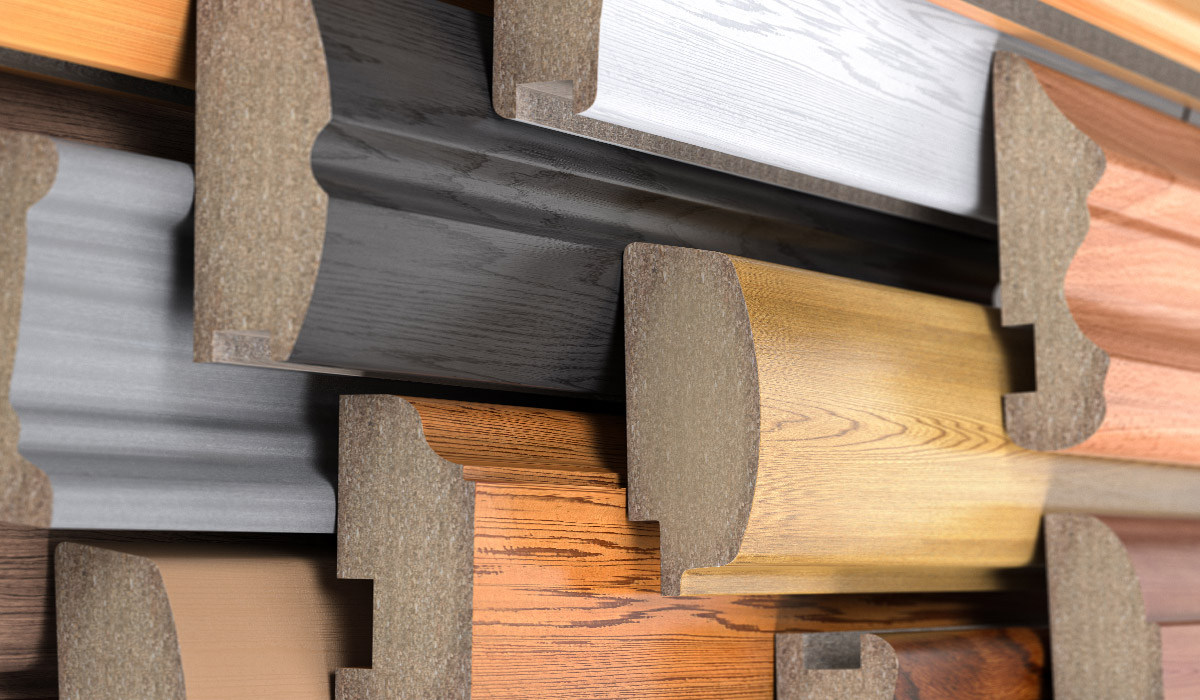
MDF Profile Wrapping: Complete Guide and Solutions from Düspohl
In recent years, MDF (Medium Density Fibreboard) has become a key material in the furniture and interior design industries, thanks to its versatility, stability, and processability.
MDF is particularly valued for creating panels, profiles, frames and components – making it indispensable for both residential and contract applications. When MDF profiles and panels are professionally wrapped, they combine visual appeal with durable performance, perfectly meeting the expectations of modern manufacturing.
Düspohl recognizes this shift and stands at the forefront of innovation for profile and panel surfaces. The company has developed advanced MDF profile wrapping machines and laminating solutions that allow manufacturers to deliver both top-of-the-line aesthetics and process efficiency, while reducing environmental impact. In this complete guide, we will provide a general overview of everything you need to know about MDF profile wrapping.
What is MDF? Characteristics and Properties
MDF (Medium Density Fibreboard) is an engineered wood panel created by compressing wood fibres with resins at medium density. The characteristics that have made MDF so popular, particularly for furniture and component finishing, are as follows.
1. Uniform density and composition
MDF provides a highly consistent structure, free from knots and structural defects. This uniformity ensures an ideal base for MDF profile wrapping, with superior surface quality and decorative results.
2. Easy to process
Cutting, drilling, and shaping MDF is straightforward and clean. Whether you are creating intricate profiles or flat panels, MDF’s workability helps optimize the efficiency of automated profile wrapping machines.
3. Sustainability
MDF typically uses recycled or recovered wood fibres that would otherwise become waste. This helps manufacturers reduce environmental impact and actively contribute to the circular economy.
Wrapped MDF: 4 Key Benefits
Professionally wrapping MDF profiles and panels - using high-quality MDF profile wrapping machines - brings tangible technical and functional advantages to your production line.
1. Smooth and compact surface
A wrapped MDF profile offers an even, flawless finish. This allows for high-end decorative foil, PVC, laminate, or paper to be applied directly and with lasting adhesion.
2. Long-term stability
An MDF profile or panel that’s properly wrapped maintains its properties over time. The protective layer shields against dust, wear and environmental factors, ensuring persistent quality.
3. Resistance to deformation and warping
The wrapping process increases resistance to humidity and temperature variations. This minimizes the risk of swelling, cracks or deformation, even in challenging environments.
4. Reduced environmental impact
Modern MDF profile wrapping machines, such as those by Düspohl, utilize formaldehyde-free hot-melt adhesives and cutting-edge energy-saving systems. Combined with the use of recycled fibres, this results in significant sustainability gains.
How MDF Profile Wrapping Works: The Process Step by Step
Behind every flawlessly wrapped MDF profile lies a precise, continuous process in which each stage directly affects the quality of the finished surface. Understanding how MDF profile wrapping works helps clarify why the right equipment and process control make such a difference. The process can be broken down into a few core stages:
- Infeed: the MDF profile is fed into the line and precisely aligned, ensuring consistent positioning throughout the process.
- Primer application: a primer is applied to the profile to prepare the surface and guarantee strong, lasting adhesion of the decorative material, even on complex geometries.
- Surface material unwinding: the decorative material (foil, veneer, laminate, PVC, or paper) is unwound from the reel and, where required, heated to a set temperature to improve bonding and reduce glue consumption.
- Glue melting and application: hot-melt adhesive is melted to the correct working temperature and applied evenly, forming the bond between profile and surface material.
- Wrapping: a series of forming and pressure rollers wraps the surface material tightly around the profile's contour, following its exact geometry for a seamless, uniform finish.
- Separating and outfeed: the continuously wrapped profiles are cleanly separated to the required length and discharged, ready for the next production step.
Each of these stages must be finely controlled and synchronized: it is the consistency across the entire process that determines the quality, durability, and appearance of the final wrapped profile.
MDF Profile Wrapping Applications
As mentioned in the previous sections, MDF profile wrapping is used to finish a wide range of components. Thanks to the versatility of MDF and the flexibility of modern wrapping lines, the field of application is remarkably broad, spanning furniture, interior design, and construction. The most common applications include:
- Skirting boards and architraves: long, linear profiles for flooring transitions and door or window casings, wrapped for a consistent decorative finish.
- Decorative moldings and profiles: ornamental and functional profiles for walls, ceilings, and furniture elements.
- Picture frames: slim, precisely contoured profiles that demand a clean, uniform surface.
- Furniture components: fronts, edges, and structural parts for both residential and contract furniture.
- Doors and door elements: including 5-piece doors and flat door components finished with decorative material.
- Window sills: profiled and wide elements for interior fittings and finishings.
- Flat panels and wide surfaces: boards and large flat elements finished through lamination as well as wrapping.
Covering such a diverse range of profiles and surfaces calls for reliable, flexible wrapping technology, which is exactly where Düspohl comes in.
How to Wrap MDF Profiles and Panels: Düspohl Solutions
For efficient and sustainable MDF finishing, Düspohl offers a complete range of machinery for both profile wrapping and flat panel lamination. Profile wrapping has been our specialty since 1967, and as part of the Cefla group, we combine decades of German engineering with ongoing innovation. Below are the solutions best suited to wrapping MDF profiles and panels on an industrial scale.
1. MultiWrap Wood: Flexible MDF Profile Wrapping Machine
The MultiWrap Wood is a robust and adaptable MDF profile wrapping machine, designed to wrap various types of wooden and MDF profiles, moldings, and frames.
Its modular approach allows quick changeovers and high-speed processing with different decorative materials: foils, veneers, CPL, PVC, and paper. MultiWrap Wood incorporates precise glue application, temperature and speed controls, and can be tailored with automation modules for feeding and stacking, making it ideal for lines requiring flexibility and high output.
Available in working widths of 250, 310, 400 and 550 mm, it processes profiles from 5 to 550 mm wide at speeds of up to 80 m/min.
2. PowerWrap Wide: Laminating Machine for Wide MDF Panels
When high productivity and surface quality are needed for flat lamination, the PowerWrap Wide excels. This machine is engineered for laminating wide MDF panels, window sills, door elements and other large surfaces.
It can apply decorative foils, laminates and technical films to flat boards up to industrial widths, all in a single pass. The PowerWrap Wide is known for its advanced glue system, efficient film handling, and rapid set-up, thus ensuring maximum throughput and precision.
Available in working widths of 700, 1000 and 1400 mm, it processes substrates from 300 to 1400 mm wide (depending on the material) at speeds of up to 40 m/min, with an automatic reel changer and integrated SynCut separating system for continuous production.
What sets the PowerWrap Wide apart is its wrapping capability: it does not simply laminate the top surface, but can also wrap the sides of the board. In a double-sided configuration, it delivers full 360° wrapping of wide panels in a single run.
3. FlatLam: Sheet Lamination for Batch-Size-One Production
The FlatLam is our latest addition to the range, designed for the lamination of individual sheets rather than continuous reel-fed material. This makes it ideal for batch-size-one production, where each MDF panel can be finished individually, for example in the manufacturing of MDF doors.
MDF Profile Wrapping: Düspohl Experts at Your Service
Combining the versatility of MDF with high-performance profile wrapping or lamination is a smart choice for today’s woodworking industry. Düspohl’s state-of-the-art MDF profile wrapping machines and panel lamination lines help you enhance both efficiency and sustainability, without compromising quality.
Want to find out how MDF profile wrapping can optimize your production, or need tailored advice for your next project? Contact our technical consultants: we are ready to help you find the ideal solution and support your business objectives.